MPG to L/100km – Accurate Conversion Formula Guide
Drivers shopping across international markets often face a perplexing numbers game. A vehicle advertised at 35 MPG in Detroit becomes 6.7 L/100km in Frankfurt, while the same car in London might list 42 MPG. These figures represent identical fuel efficiency, yet the measurement systems appear contradictory at first glance.
The conversion between miles per gallon and liters per 100 kilometers remains one of the most frequent calculations in automotive comparison. With the United States Environmental Protection Agency using MPG since the 1970s and the European Union mandating L/100km under current WLTP standards, understanding the mathematical bridge between these systems prevents costly misinterpretations.
This guide provides the exact formulas, derivation from national standards, and practical reference points for accurate conversion.
How to Convert MPG to L/100km
US Standard Formula
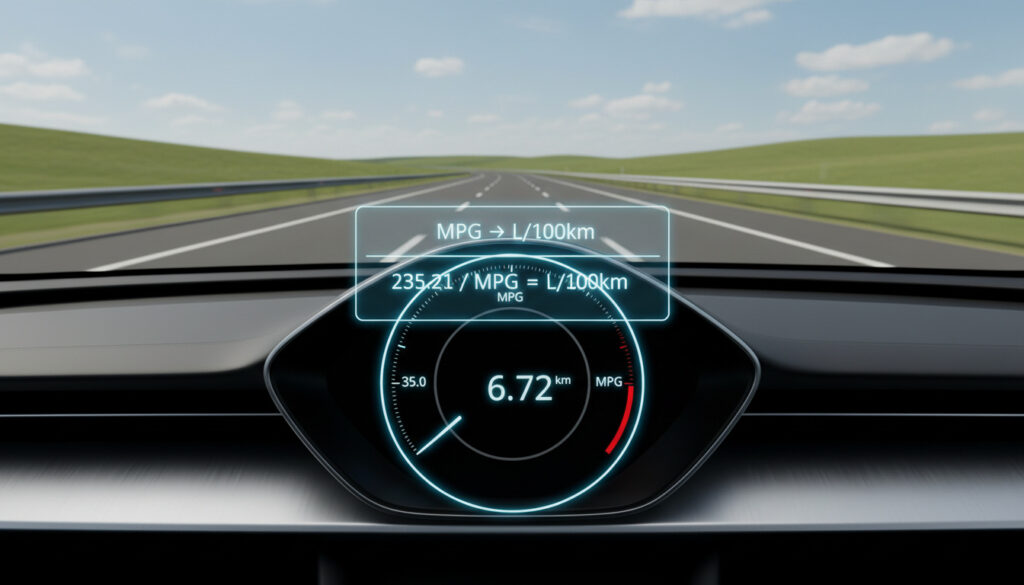
L/100km = 235.2145 ÷ MPG (US)
UK Imperial Formula
L/100km = 282.481 ÷ MPG (Imperial)
Efficiency Direction
Lower L/100km indicates better fuel economy
Reverse Calculation
US MPG = 235.2145 ÷ L/100km
Critical Conversion Insights
- Standard Constants: The factor 235.2145 derives directly from NIST definitions: 1 US gallon equals 3.785411784 liters and 1 mile equals 1.609344 kilometers.
- Gallon Confusion: The US gallon (3.785L) differs from the UK Imperial gallon (4.546L) by approximately 20%, making mixing these formulas produces significant errors.
- Inverse Logic: Higher MPG values indicate better efficiency, while lower L/100km values indicate better efficiency.
- Regulatory Context: EPA fuel economy labels utilize US MPG, while EU regulations since 2017 require L/100km under WLTP testing cycles.
- Real-World Variance: Laboratory test figures typically exceed actual driving results by 20-30% due to traffic and weather conditions.
- Hybrid Benchmarks: Vehicles like the Toyota Prius achieve 50-60 US MPG, converting to approximately 4.7-5.0 L/100km in laboratory conditions.
Conversion Reference Table
| US MPG | L/100km | UK MPG (approx.) | Efficiency Rating |
|---|---|---|---|
| 1 | 235.2 | 1.2 | Extremely inefficient |
| 5 | 47.0 | 6.0 | Poor economy |
| 20 | 11.8 | 24.0 | Average sedan |
| 30 | 7.8 | 36.0 | Good economy |
| 35 | 6.7 | 42.0 | Efficient |
| 50 | 4.7 | 60.0 | Hybrid standard |
| 70 | 3.4 | 84.0 | Maximum efficiency |
MPG to L/100km Formula Explained
Mathematical Derivation
The conversion constant 235.2145 emerges from precise unit definitions established by the National Institute of Standards and Technology. One US gallon contains exactly 3.78541178 liters, while one statute mile measures 1.609344 kilometers. The formula derives from converting the ratio of miles per gallon into liters per 100 kilometers through dimensional analysis: (3.78541178 liters × 100) ÷ (1.609344 kilometers × MPG) = 235.2145 ÷ MPG. Inch Calculator provides the step-by-step algebraic breakdown.
The US vs. UK Gallon Problem
International confusion often stems from the gallon itself. The Imperial gallon used in the United Kingdom equals 4.54609 liters, roughly 20% larger than its US counterpart. Consequently, 30 US MPG converts to approximately 36 UK MPG, representing identical fuel consumption. Omni Calculator demonstrates this divergence with comparative tools.
Using the US formula (235.2145) with UK MPG figures produces inflated efficiency ratings. For Imperial conversions, apply the constant 282.481 instead. A vehicle rated 40 UK MPG achieves 7.1 L/100km, not the 5.9 L/100km the US formula would suggest.
For UK-specific calculations, MPG Calculator UK offers localized conversion tools that automatically apply the Imperial constant.
MPG vs L/100km: Which Measurement Works Better?
Inverse Scales and Consumer Psychology
The two systems measure opposite relationships. MPG expresses distance per volume (miles traveled per gallon consumed), while L/100km expresses volume per fixed distance (liters consumed per 100 kilometers). This inversion creates a cognitive trap: improving from 10 to 20 MPG saves more fuel than improving from 40 to 50 MPG, though the numerical gain appears identical. The L/100km scale linearly represents fuel costs, making consumption differences immediately apparent.
Global Standards and Labeling
North American markets predominantly display EPA-tested MPG figures, though Canada officially uses L/100km despite proximity to US markets. European Union regulations mandate L/100km exclusively, with the Worldwide Harmonised Light Vehicle Test Procedure (WLTP) providing standardized laboratory figures since September 2017. MPG to Litres maintains updated context on these regulatory environments.
Australia, New Zealand, and Japan utilize L/100km alongside kilometers per liter. The United Kingdom presents a unique hybrid environment where road signs display miles, yet new car window stickers increasingly show L/100km alongside MPG to comply with EU trade standards.
MPG to L/100km Conversion Examples
Practical application reveals the stark differences between laboratory ratings and operational reality. A mid-size sedan achieving 35 US MPG in EPA testing theoretically consumes 6.72 L/100km. However, urban driving with climate control and traffic congestion typically yields 8.5-9.0 L/100km, equivalent to 26-28 MPG.
Hybrid vehicles illustrate the upper range of current technology. The Toyota Prius laboratory rating of 50-60 US MPG converts to 4.7-5.0 L/100km, though owners report real-world figures closer to 40-50 MPG (5.9-7.1 L/100km) depending on temperature and driving style. Omni Calculator confirms these equivalence ranges.
When budgeting fuel costs, add 20-30% to L/100km laboratory figures for city driving and 15-20% for highway use. Conversely, expect 15-25% lower MPG than sticker values in mixed driving conditions.
For shoppers evaluating Mercedes A-Class For Sale – 2024 Prices, Specs and Dealers, understanding these conversions proves essential when comparing European specification sheets against domestic efficiency expectations.
Evolution of Fuel Economy Standards
- EPA establishes the US MPG standard for window stickers following the oil crisis, creating the first national comparison framework.
- The European Union transitions from the outdated NEDC test cycle to WLTP methodology, retaining L/100km but providing more realistic consumption figures.
- Divergent systems persist globally, with no international harmonization on the horizon despite electric vehicle adoption changing how efficiency is measured.
Established Facts vs. Common Variables
Confirmed Standards
- NIST defines 1 US gallon as exactly 3.785411784 liters
- The conversion constant 235.214583… is mathematically precise
- EU law mandates L/100km for all new vehicle sales
- EPA requires MPG on US vehicle labels
Variable Factors
- Real-world consumption gaps vary by driving style and region
- Temperature effects on battery efficiency in hybrids
- Fuel quality variations affecting actual MPG/L/100km
- Future potential for unified global standards remains unclear
Sources and Measurement Authorities
“The conversion from miles per gallon to liters per 100 kilometers relies on exact definitions: 1 mile equals 1.609344 kilometers and 1 US gallon equals 3.785411784 liters.”
— MPG to Litres, referencing NIST standards
“Laboratory test figures often exceed real-world results by 20-30% due to factors including traffic conditions, weather, and individual driving habits.”
— Inch Calculator
“To convert L/100km back to US MPG, divide 235.2145 by the L/100km figure.”
Summary of Key Conversion Principles
Accurate fuel efficiency comparison requires applying the correct constant for the specific gallon measurement in use. For US specifications, divide 235.2145 by the MPG figure to obtain L/100km. For UK specifications, use 282.481. Remember that these laboratory-derived figures typically represent optimistic scenarios, and actual consumption will vary based on operational conditions. When researching efficiency across vehicle categories, from compact cars to Ride On Lawn Mower – Best 2026 Models Reviews, applying these conversions ensures accurate cost comparisons.
Frequently Asked Questions
Is there an online calculator for MPG to L/100km?
Yes, multiple validated calculators exist. MPG to Litres and Omni Calculator provide instant conversion tools that handle both US and Imperial gallon distinctions automatically.
Does the UK use MPG or L/100km for official figures?
The UK uses both. While road distances remain imperial, new car window stickers display L/100km alongside MPG to align with EU trade regulations and WLTP testing standards.
What is considered a good L/100km rating?
Ratings below 6.0 L/100km indicate excellent efficiency (equivalent to 39+ US MPG), 6.0-8.0 L/100km represent average economy, and figures above 10.0 L/100km indicate poor efficiency comparable to sub-24 US MPG.
Why does Canada use L/100km while the US uses MPG?
Canada adopted the metric system in the 1970s, aligning with international standards for trade and scientific consistency, while the United States retained customary units for consumer familiarity.
How do I convert 50 MPG to L/100km?
For 50 US MPG, divide 235.2145 by 50 to get 4.7 L/100km. For 50 UK MPG, divide 282.481 by 50 to get 5.65 L/100km. Always verify which gallon standard applies before calculating.
More related posts
 Weather in Benidorm Today – Hourly Forecast and Weekend Outlook
 Virgin Island Channel 4 – How to Watch Season 2 and Apply
 Real Madrid vs FC Barcelona – Super Cup Final Preview and Prediction
 HD Parque Cristobal Gran Canaria – Family Resort Guide 2025
 Nancy Allen – Iconic Roles in Carrie and RoboCop
 Mark Goldbridge – Real Name, Biography and YouTube Career
 Prince of Persia The Lost Crown – Price, Reviews and Sequel News
 The Devil Made Me Do It – True Story and Trial Facts