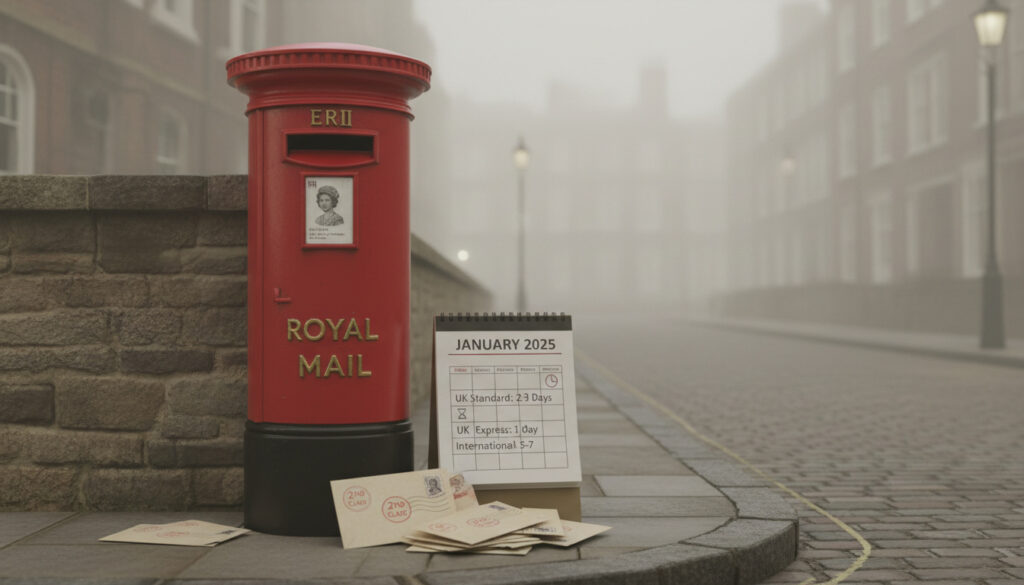
How Long Does Second Class Post Take – Royal Mail 2025 Guide
Second class post has long served as the economical backbone of UK domestic mail, offering a cost-effective alternative for non-urgent correspondence. Recent regulatory reforms have fundamentally altered how these items move through the network, introducing alternate-day delivery schedules and revised performance targets. The current timeframe depends on both Royal Mail’s official targets and the operational reality of network-wide changes introduced in 2025.
The service now operates on a reduced weekday schedule, with significant implications for anyone calculating delivery windows. While first-class post maintains its Monday-to-Saturday rotation, second-class items face new constraints that affect everything from Friday postings to weekend expectations.
How Long Does Second Class Post Take?
95% delivered within 3 working days
2 to 3 working days
Not available
Up to £20 for letters
- Ofcom mandates that 95% of second-class mail arrive within three working days, reduced from the previous 98.5% target
- Real-world performance during the 2024/25 financial year saw 92.5% of second-class items delivered on time
- Letters posted on Fridays are typically delivered by the following Wednesday under the new alternate-day schedule
- First-class post maintains a 90% next-day delivery target, though actual performance reached only 77%
- The backstop target requires 99% of all mail to arrive no more than two days late
- Compensation cover up to £20 applies to second-class letters up to 100g
- Reform implementation across 1,200 delivery offices spans 12 to 18 months
| Item Type | Ofcom Target | Typical Duration | Exceptions |
|---|---|---|---|
| Standard Letters | 95% within 3 days | 2-3 working days | Alternate weekdays only |
| Large Letters | 95% within 3 days | 2-3 working days | Mon-Fri delivery only |
| Small Parcels | 95% within 3 days | 2-3 working days | No Saturday service |
| Friday Postings | Following Wednesday | 3-5 calendar days | Week 1/Week 2 rotation |
| Signed For 2nd Class | 95% within 3 days | 2-3 working days | Signature required |
| Bank Holiday Periods | Extended windows | +1-2 days | Public holidays excluded |
First Class vs Second Class Post: Delivery Time Comparison
The gap between first and second-class services has widened significantly following recent reforms. First-class post retains its Monday-to-Saturday delivery schedule with a 90% next-day target, though real-world performance data from 2024/25 shows only 77% achieved this standard.
Second-class post operates on a fortnightly cycle introduced on July 28, 2025. One week sees deliveries on Monday, Wednesday and Friday, while the following week operates on Tuesday and Thursday only. This contrasts sharply with first-class six-day service.
Does Second Class Post Deliver on Saturdays and Other Exceptions?
Saturday delivery is no longer available for second-class post. Royal Mail eliminated weekend deliveries for second-class items as part of cost-cutting measures, while maintaining Saturday service for first-class mail.
The alternate-weekday system means posting items on Friday results in delivery the following Wednesday at the earliest, depending on which cycle week falls after posting.
What to Do If Your Second Class Post is Late
Standard second-class post includes compensation cover capped at £20 for letters up to 100g. This applies only to loss or damage, not to delays within the three-working-day window.
Royal Mail offers Signed For® 2nd Class for items requiring additional security, providing signature confirmation upon delivery. However, standard second-class items do not include tracking capabilities. For digital alternatives, see our guide on How to Make a QR Code for Free – Step-by-Step Guide.
Regulatory enforcement remains stringent. Ofcom imposed a £21 million fine on Royal Mail in March 2026 for missing delivery targets, marking the third-largest penalty issued by the communications watchdog.
During the 2024/25 financial year, Royal Mail delivered 92.5% of second-class mail on time, falling short of the 95% target. First-class performance reached just 77% against a 90% target.
What Is the Typical Journey for Second Class Mail?
- Day 0: Posting at mailbox or collection from business premises. Items enter the network and begin processing.
- Day 1: Transit to regional sorting facility. Mail undergoes automated sorting and route allocation based on the alternate-day delivery schedule.
- Day 2: Distribution to local delivery office. Items align with the current week’s delivery pattern (Mon/Wed/Fri or Tue/Thu).
- Day 3: Delivery window. 95% of items should reach recipients by this point under Ofcom regulations.
- Beyond Day 3: Late threshold. Items not delivered within three working days trigger backstop compliance monitoring, though compensation for delay alone is not standard.
What Remains Certain vs Uncertain About Delivery Timeframes?
| Established Facts | Uncertain Factors |
|---|---|
| 95% delivery within 3 working days is the regulatory target | Exact timing for specific rural postcodes |
| No Saturday deliveries for second-class post | Impact of future industrial action on delivery times |
| Alternate weekday schedule: Week 1 (Mon/Wed/Fri), Week 2 (Tue/Thu) | Consistency of service during peak periods (Christmas) |
| Compensation up to £20 available for lost/damaged items | Precise rollout dates for remaining delivery offices |
| Friday postings arrive by following Wednesday | Regional variation in processing speeds |
Why Has Royal Mail Changed Second Class Schedules?
Royal Mail recorded a loss of £348 million in 2023-24, prompting the Universal Service Provider to seek operational efficiencies. The alternate-day delivery model projects annual savings between £250 million and £425 million.
Implementation progresses gradually across 1,200 delivery offices over 12 to 18 months. As of March 2026, pilots were running across 35 delivery offices, with wider rollout delayed until early 2026.
Ofcom continues reviewing stamp pricing separately to address affordability concerns while maintaining the universal service obligation.
What Do Regulators and Royal Mail Officially State?
“The backstop target requires 99% of all mail to arrive no more than two days late, ensuring that even when items miss primary targets, they cannot be delayed indefinitely.”
— Ofcom Regulatory Framework, via The Independent
“Letters posted on Friday are typically delivered by the following Wednesday, depending on which week of the fortnightly cycle falls after posting.”
Key Takeaways on Second Class Delivery Times
Second-class post currently targets delivery within three working days for 95% of items, operating on an alternate-weekday schedule without Saturday service. While typically arriving within two to three days, Friday postings may take longer due to the fortnightly rotation system. Those requiring faster delivery or certainty should consider first-class alternatives, much like those researching What Is the Fastest Way to Cure a Stomach Ulcer? – Proven Healing Timelines seek definitive solutions.
Frequently Asked Questions
What counts as a working day for Royal Mail second class post?
Working days exclude weekends and bank holidays. Royal Mail processes and delivers second-class mail Monday through Friday only, operating on an alternate-day fortnightly cycle.
Is second class post faster than it used to be?
No. The target has been relaxed from 98.5% to 95% within three working days, and Saturday deliveries have been removed. The service is slower than historical standards.
Can I track a standard second class letter?
Standard second-class post does not include tracking. You must purchase Royal Mail Signed For® 2nd Class or use Tracked services for delivery confirmation.
How do I claim compensation for late second class post?
Compensation applies only to lost or damaged items, not delays. Claims require proof of posting and evidence of loss. Standard letters are covered up to £20.
Why did my second class post arrive next day?
While targeting three-day delivery, Royal Mail may process second-class items alongside first-class mail when capacity allows. This is incidental and not guaranteed.
Does the alternate-day schedule affect all UK regions equally?
The rollout occurs gradually across 1,200 delivery offices. Some areas may operate under old schedules while others use the new fortnightly cycle.
Are large letters treated differently to standard letters?
Both follow identical delivery targets and schedules. The three-working-day aim applies regardless of size within second-class parameters.
More related posts
 John McGinn – Biography, Age, Career, and Personal Life
 Jeff Hordley – Age, Wife, Illness, and Career
 SA-W vs EN-W – Head-to-Head Records and Stats Analysis
 Post Offices Near Me – Branch Finder, Opening Times & Locations
 HbA1c Normal Range UK – NHS Thresholds and Charts
 Greatest Hits Radio Competition – How to Enter and Win Prizes
 Chessington World of Adventures – Rides Map and Tips 2025
 HD Parque Cristobal Gran Canaria – Family Resort Guide 2025